
Made Winter 2009
Winter is coming,
winter is here.
Rolling across my fingers and eating into my branches below.
The leaves I use to feel the world crinkle and fade.
Their dust coats the ground and insulates my core.
As winter grasps my hand,
it wipes away the fingerprints left by others.
And I think there is something beautiful,
in my new found nudity.
Showing posts with label Mine. Show all posts
Showing posts with label Mine. Show all posts
Thursday, September 23, 2010
Naked Trees

The Roaming Days


obscure, 1
obscure, 2
obscure, 3
Artist statement from final show in Rome:
“I think that our sense of realism has been changes to some extent since surrealism- well, really, since Freud- because we’ve been made more conscious of how realism can drawn on the unconscious….I believe that realism has to be re-invented. It has to be continuously re-invented…I believe that reality in art is something profoundly artificial and that it has to be re-created otherwise it will be just an illustration of something – which will be very second hand.”
-Francis Bacon
This quote by artist Francis Bacon taps directly into the ideas I am exploring in my photography projects. Living in a foreign country and surrounding yourself with a completely unfamiliar context inevitably causes some recreation of your personal reality. You remain caught between the familiar and the unfamiliar, the reality of existing where you are, and the dream of your presence somewhere seeming so unreal. The images taken inside a camera obscura, illustrate this idea by contrasting a normal room, with unnatural depictions of the outside streaming across the walls. The experience of seeing these images in the room they were taken, but warped by the affects of a camera obscura causes a disorientation and hopeful reconsideration of reality, similar to the experience of studying abroad.

seen, unseen
(click on image to view full scale)

within, without
In addition to being caught between the realities I am familiar with and the reality of living in Italy, I have also observed Rome as a place caught between opposing forces. Between it’s history as the once most powerful empire in the world, and now how that history is preventing it from modernizing. Between the ever-present Catholicism, muddled with depictions of Greek Gods. Between the gender roles and relationships of the old world contrasted with those of the new. I explored this idea with a series of blurred images of the heavenly virtues and deadly sins, which leave the viewer unsure of which is good and which is evil. The interaction between the two makes their seemingly clear distinction less apparent. The dark doorway begs for one to follow the unknown path- the portal between these distinct poles, and the place to find a new, individual reality. This is an unfamiliar place where, like in Rome, these polar forces collide and find an identity in the space in-between.

virtue and sin
(click on image to view full scale)
Monday, November 9, 2009


Collections
I decided to continue doing similar "collections" to the first one I did while in Seattle. Every place I've gone while in Europe, I have been collecting random objects around the city and photographing them together. The objects are usually insignificant and often broken, but my hope is that by putting them together- piecing them into the same frame, and photographing them in good light, they can become beautiful and whole again.
The objects are always photographed in or around the place that I stay while in each place. Since these found "things" are essentially my only possessions (other than the clothes and few items I have with me), it seems only fitting that they be in the place closest to my "home".
I select the objects with no particular pre-requisite in mind. Just anything I notice, or that catches my eye. Some collections are much larger than others, and some follow more patterns (things found on the beach, construction tools) which provides an interesting commentary on each city I'm in.
The thing I like most about these collections is that they seem to capture the feelings of being in a new place and trying to digest a myriad of new stimuli. The result is a fragmented and jumbled experience grounded only by a memory of the place you were.

Edinburgh, Scotland
fall flowers, old sea glass, red rock, new shell, yellow rock, spiral shell, tree coral, lost reminder, castle wall, yellow leaf, old shell, early Christmas, blind pirate, naked seagull, would-be sea glass
 Florence, Italy
broken piece of old wall, found blue button, shiny shard, metal tube, lost blue note in Italian, metal vertebra, drunken couple, piece of new wall, purple broken sacrifice , tightly packed glass shards, metal hook
 Venice, Italy
once glowing red leaves, questionable bottle, tree brains, 'love therapy' gnome

Palermo, Italy
broken mosaic, red flowers, wired glass, half of a postcard, spring, light bulb remnant's, volcanic rock, green gem from trash pile, red leaves, banyon tree seed, tooth/rock, curious metal disk

Syracuse, Italy
ocean floors, strange rock, banyon tree seeds, snail shells found in ruins, old tiles, rock with fossil imprints, bird bone
Friday, September 25, 2009
Bringing War Home
- Images taken Fall of 2008-
"Bringing War Home"
Large Format B&W Prints
Double Exposures with Stenciled Layer Mask
Civil War

World War II

Vietnam War

Iraq War
Inspiration:
In making each of these photos, the black shapes were made from actual images taken in each war. Meaning Hitler stands on the end of the WWII image and they are Iraqi solders hiding in front of the house. In this series I was thinking about the way war is portrayed, and how images are transient across time periods. When the weaponry is blurred to black, it is difficult to distinguish one time from another. The images steaming into our homes are a single dimensional portrait of war, which will never be able to depict the entirety of being in the battlefield. In this way, they become a cartoonist depictions shaped by our shallow comprehension of war and animated by our expectations of it's likeness.
Monday, August 31, 2009
The Story of My Favorite Dress

dress
v. dressed, dress·ing, dress·es
v.tr.
 1. To decorate or adorn.
 2.To furnish with clothing.
 3. To arrange a display in.
 4. To garnish.
 5. A one-piece outer garment for women or girls.
Tuesday, July 21, 2009
Outta My Light
Great photography always boils down to great "photo", in it's literal sense. Although light should always be taken into consideration when taking a photograph, light itself can often times be the subject.
In the word of "Little Wings":
Got it like a ghost that girly gleaming
Look at what the light did now
Look at what the light did now
"Through the window"
Black and White Digital Images


 "Tea Cups"
Studio Lit
Black and White Digital Images

Saturday, April 18, 2009
Adoration of an Oxymoron
Stop motion. I didn't realize I was so interested in this until someone actually showed me what it was. Looking back, I see my intrigue in the concept started long ago. Two years ago, to be exact. I did a photo project which had to center on a randomly assigned word. Mine was was "instant". So I made a series intended to look like film stills, because "instant" to me was a type of measurement, a precise sliver of time which often lacks transition before or after.


 Fall of this year, I continued with this interest, and took a series of photographs and composed them into a film. The images were shot with the intention of being stills, but I started playing with the idea of creating a sort of "digital flip book". This was a rather unsuccessful attempt as the motion is choppy and it's rather repetitive, but it marks the beginning of my understanding of stop motion animation.
Exchanging Niceties with a Tree
Song "Lighthouse" by Electrelane
From there I was finally introduced to the concept of "stop motion" after seeing "Muto" by Blu (see below). I fell in love with the oxymoron right then and there. The wonderful thing about stop motion is that it works both ways. It can take something that is not moving at all and give the illusion of motion by sheer number of images and speed of viewing to make a satisfying deception for the viewer. The photos are still, the camera is still, and the inanimate objects in the photos are still. The only time things are moving is when there is no camera to record it's actual motion. Or it can take something that is moving, like a person, freeze parts of their motion with a photograph and reshape that movement with a film.Whether motioning what is stopped or stopping what is in motion, the trickery is oh so charming.
Here are a few of my favorite stop motion films:
(Thanks Maggie!)
(Thanks Ethan!)
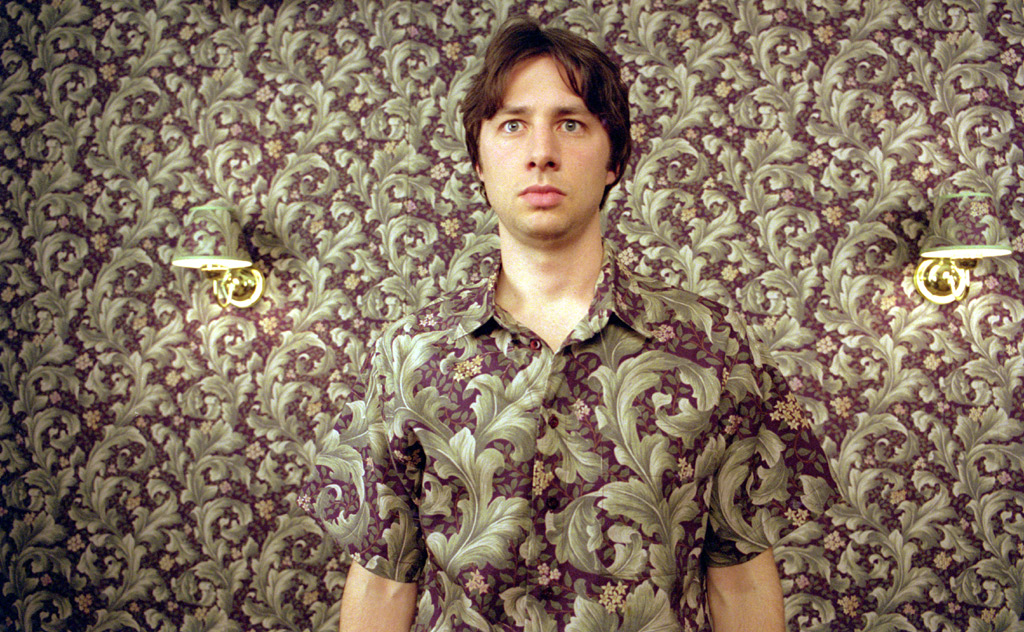
Finally I decided to tackle this primal form of animation myself. I struggled significantly (see entry below) in finding a solid idea for the project. However, I became interested in the concept of metamorphosis, and specifically, the caterpillar to butterfly transition. This is where the title "Holometabolous" comes from, meaning "complete metamorphosis." As a college student, I was thinking about how transient life is during this period. It is the time when so many people are tying to "find themselves" but are doing so in a setting where classes, friends and current home are in a constant flux. We spend so much time adapting that it is impossible to really map your identity. Plus if you were to identify yourself completely, it would be that much more difficult to handle the inevitable future transition.
The Garden State
I also don't think people give enough credit to their context. We all find ways to adapt or affiliate with our background, and must accept that our sense of self must adapt too. Essentially, identity is malleable, and the only way to really find it is to accept that, to an extent, you will always be searching for it.
Holometabolous
"Know thyself. A maxim as pernicious as it is ugly. Whoever studies himself arrest his own development. A caterpillar who seeks to know himself would never become a butterfly."
-Andre Gide
Monday, March 30, 2009
The Photographer’s Dilemma
 "Looking Between the Lines"
Scanned black and white negative
I had bad case of artist block in formulating a solid idea for my final photography project. The more I thought about my intentions and how represent those ideas visually, the more my creative thought seemed to be pushed further out of reach. This got me thinking about the process of making art. For most artists, the meaning is dissected after the art is created. For others, there is a higher level of intentionality established before approaching the work. I feel that I weave between these two methods depending on the assignment, but more commonly, I decide where I am going conceptually before making the visual map to get there. Although I believe this can make the art more meaningful, other times I think I drown my creativity with too much logic. It is a fine line between giving art enough thought to find the method most conducive to the idea, and submerging art’s ability to access the illogical by trying to articulate it’s existence with reasoning.
There is also the flip side of this as a viewer rather than creator. Why do people look at art? And what are we supposed to take from art? Sometimes I think art should be brought into the logical realm, by dissecting its meaning and significance. Other times, I think it begs to be left alone, left as something unexplainable.
As I was contemplating my struggle, I thought about this particular challenge in terms of photography. Unlike painters, sculptures or other artists who have a much more hands on approach, photographers must always operate through another medium: their camera. In doing this, one has to juggle the logical side of how to operate this machine, and the creative side of what this machine can see or do. Therefore the artist must also master the maneuvers of this tightrope walk between using reasoning to operate the machine and innovation to make artistic photographs. "Peek"
Scanned Digital Negative
This discussion has its place physiologically in terms of the left and right hemispheres of the brain. The left hemisphere controls the right side of the body and is the part used for linear, symbolic processing, speaking, and reasoning. The right hemisphere controls the left side of the body and is used for holistic, random, intuitive thinking or fantasizing. Most people become dominate in one of these hemispheres, and for most artists it is the right.
Photography however, prevents either hemisphere from becoming dominate. To look through your camera at the picture being created you must close your left eye and look with your right. By doing this, you are activating the left hemisphere, which is used for rational thought. As a fine art photographer, the right brain needs to be used to see the image as a something other than a representation. This then is the photographer’s dilemma; to create art as the right brain would, despite using your left brain to make it.
"Hidden Identity"
Acrylic on canvas
My solution to this conundrum was to put my camera down and start making finger paintings. This overly crude method of making art allows a certain catharsis limited in photography. By plopping the paints directly on the canvas and allowing my fingers to mix the colors and create the shapes, I am able to bi-pass the road block of intentionality. I can expel my creative energies directly on a canvas, messy as they may be.
It turns out messy is sometimes the only antidote for a photographer facing a blank canvas.
Monday, February 9, 2009
Unicorns for Christmas

"Starry Structures"
Digital photo collage
I've decided to start this blog primarily for self-serving reasons, but also as a way to share the images I spend so much time with my camera creating. In my Contemporary Issues in Photography course, we were asked to define the type of photographs we like to take. I sat there in contemplation, bumbling over an accurate definition of my work. Mainly, because I don't think a good definition is available at this point. However, my intention is to use this blog as a means to find it. By creating a chronology of my work, posting project ideas and noting the artists who inspire me, I hope to lay the framework for such a definition. Although this is not the ideal way to display my photographs and art, I think it allows for explanation and exploration that other avenues do not.
I have been hesitant in the past to post any images or artwork. I feel like it's flaunting it. I don't want to presume authority over something I am still learning. However, I also feel that keeping my art in various folders in my room is almost insulting it's existence. I do consider myself an artist, but this does not mean I see myself as someone who is always creating impressive art. I only request that you as a viewer and critique bear this in mind. I am, however, eager for feedback (even if critical) if you care to share.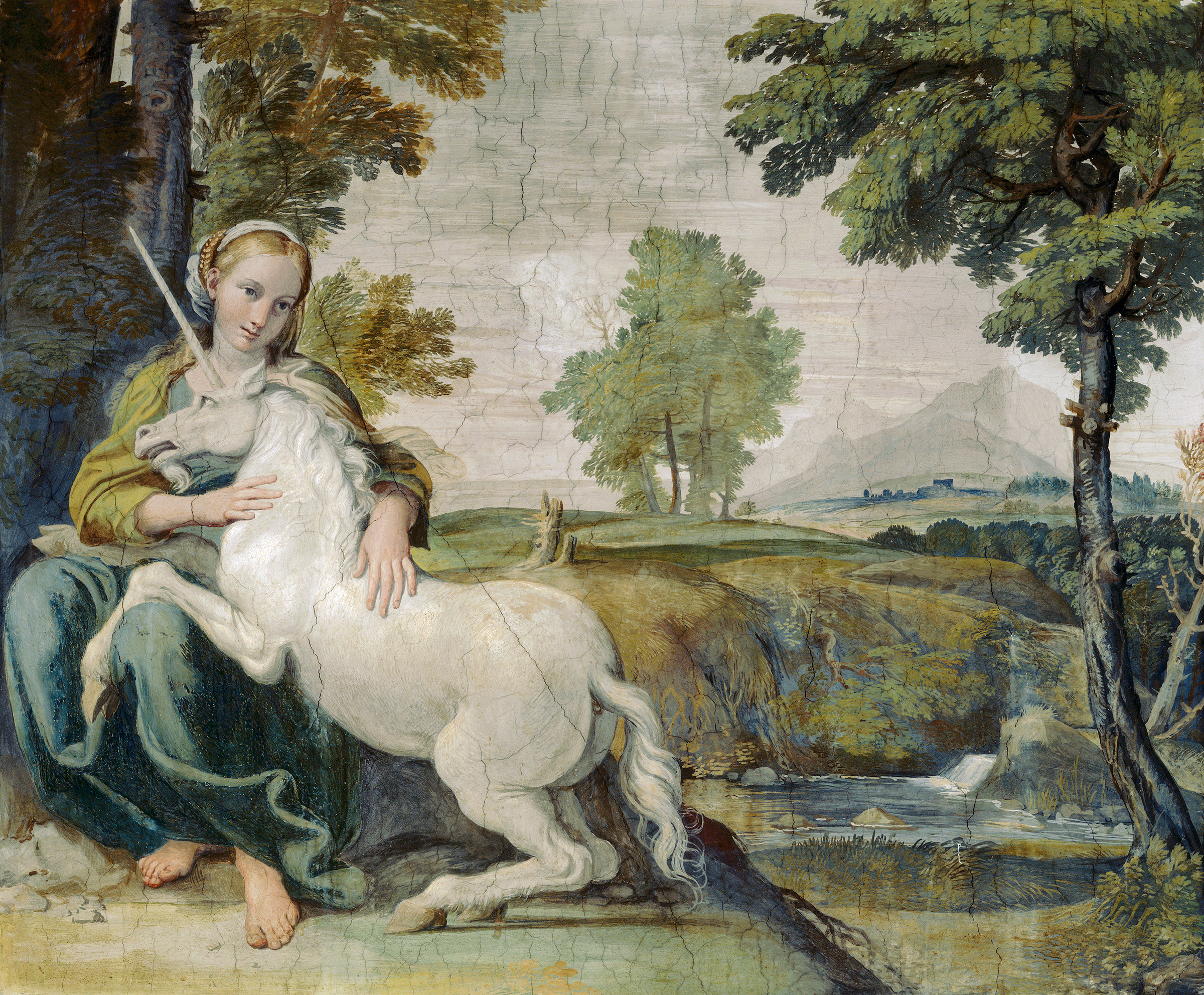
Fresco, Palazzo Farnese, Rome
probably by Domrnico Zampieri, ca 1602
On that note, why "Unicorns for Christmas"?
I came to this title after the recent birth of an infatuation with unicorns. Unexpected snowstorms in the Northwest left me housebound and restless, which, logically, only leads to research of this mythical creature. My obsession led to Christmas wishes for a unicorn, which led to nostalgia of my younger days when wishes for magic were within reason. As a child, there were multiple accounts where my requests to the holiday mascots were not only impossible, but imagined. I asked the Tooth fairy for the ability to fly, I asked Santa for a bell from his sleigh, and the Easter bunny for a whistle to talk to animals.
Although I have outgrown the faith in such wishes, I feel that the thought process of this childhood logic has not completely disintegrated. It has transcended into my art. The photo series I make are intended to push the bounds of reasonable thought. I want to challenge the organization of our schema by challenging what we see. As Santa and Tooth fairy know well; seeing is believing, and herein lies the power of photographs. Jumbling our view of time, space, identity, gender and logic can be done with no better medium than a visual one. If I am able to poke through the membranes encasing any of these within our minds, then I believe this is success as an artist.
In my course I wrote down "Challenging conventional ways of thinking" to define my work. This is what I have now, but we shall how this definition morphs.
And so it begins.
Subscribe to:
Posts (Atom)
